Concrete Cleaning: The Green And Black Stuff Is Almost Never Mold
The growth on concrete and pavers is almost never mold. What it actually is, what takes it off, and why pavers take pressure a roof never could.
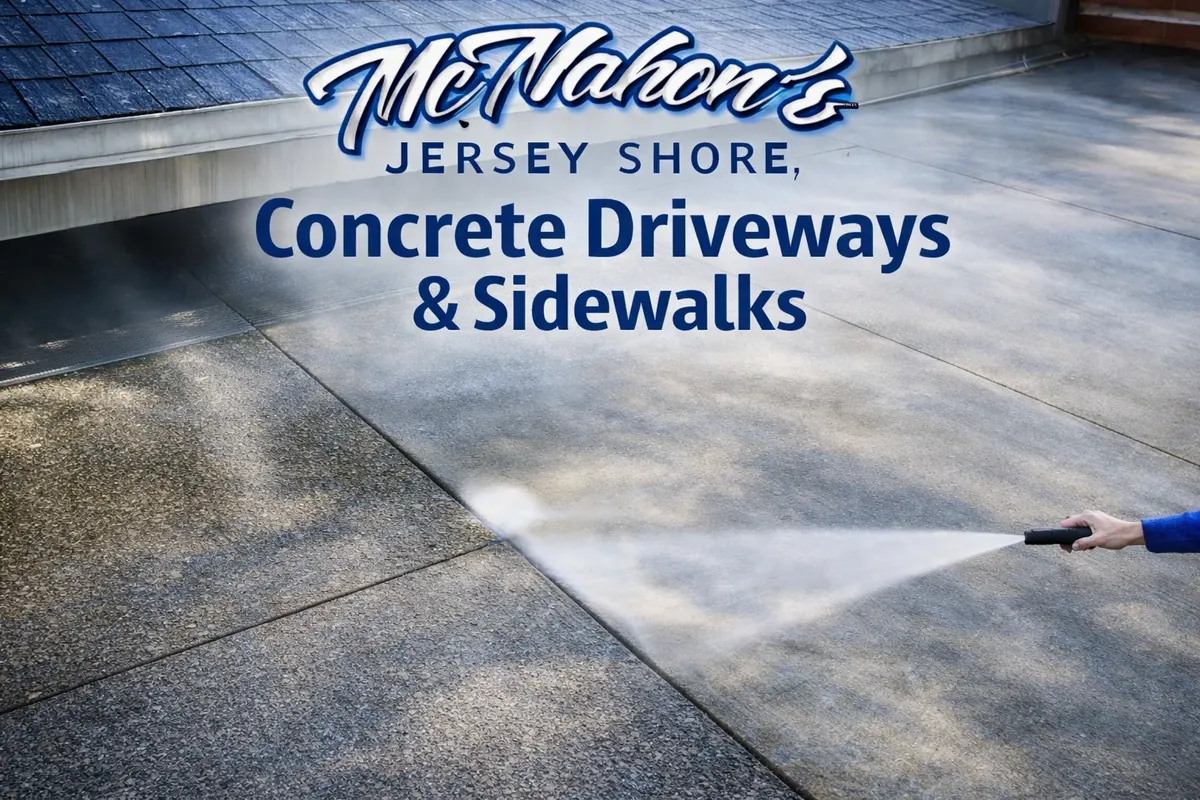
Every spring we get calls about mold on a driveway, a patio, or a paver walkway. The homeowner is usually right that something is growing and wrong about what it is, and the misdiagnosis matters because it changes the tool.
Quick Answer
To kill mold on concrete you first have to accept that it is almost never mold. Mold is a fungus and it has to eat something organic; concrete is sand, cement, and stone, and there is nothing in it for a fungus to feed on. What is actually growing is algae in nine cases out of ten, sometimes moss, occasionally lichen. All three die to the same thing, a dilute sodium hypochlorite solution, and the practical difference from a roof is the pressure. Concrete and pavers get a flat-rotary surface cleaner at 3,000 to 4,000 PSI, which is the correct tool for unsealed concrete, brick, and pavers. A roof gets under 100 PSI and nothing else. Same chemistry, opposite machine.
What Is Actually Growing
Four different things get called mold on a hard surface, and they are not interchangeable.
Algae. Green, sometimes greenish-black, slick when wet, and the single most common answer. It photosynthesizes, so it needs light and water and nothing else. It does not need to eat your concrete, which is why it grows happily on a surface with no organic content at all.
Moss. Green, thick enough to feel with a hand, grows in clumps and mats in joints and low spots. It is a plant with rhizoids that anchor into mortar joints and paver sand. We wrote about moss on roofs separately because the removal method there is genuinely different.
Lichen. Flat gray-green or orange crusty patches that look painted on. It is a fungus and an alga living together, and it is the most stubborn of the three because the fungal half grips hard.
Actual mold or mildew. It happens, but not on the concrete. It grows on the film of organic material sitting on top of the concrete: pollen, dust, leaf litter, grass clippings, the thin layer that builds up on a surface nobody cleans. Pressure wash the film off and the mold has nothing left to live on.
One more thing people mistake for growth: if the staining is white or chalky rather than green or black, that is efflorescence, which is mineral salt migrating out of the concrete. It is not alive and bleach does nothing to it.
Why Getting This Right Changes The Quote
If you call three companies and say mold, one of them will quote you a mold remediation price for a job that is a wash.
Algae, moss, and lichen all die to the same dilute sodium hypochlorite solution. There is no specialty concrete mold remover that works better than the thing already in the tank, and the products sold as one in a hardware store are mostly the same chemistry at a worse dilution and a higher price per square foot. What varies between a good job and a bad one is not the chemical. It is whether the person holding the wand knows which surface takes pressure.
The Pressure Answer Is Different On Every Surface
This is the part that gets skipped, and it is the reason blanket advice about soft washing everything is wrong.
Unsealed concrete, brick, and pavers: high pressure, through a surface cleaner. A flat-rotary surface cleaner at 3,000 to 4,000 PSI is the right tool. It spins two jets under a shroud so the force lands evenly, and it leaves no stripes. Concrete can take this. Holding back on pressure here just means a gray driveway with clean patches.
A roof: under 100 PSI, no exceptions. Asphalt shingles are a layer of ceramic granules held in asphalt, and pressure takes the granules off. The chemistry does the work and the dead growth sheds over weeks.
Asphalt driveways: we do not pressure wash them at all. Pressure strips the binder that holds the aggregate together. A blacktop driveway that has been pressure washed looks clean and then starts shedding stone.
Composite decking: whatever the manufacturer allows, and no more. Trex, TimberTech, and Fiberon all publish a pressure ceiling, and exceeding it furs the surface permanently.
Four surfaces, four answers. Anyone who gives you one number for all of them is guessing.
The Mistake That Costs You Joint Sand
The specific way a paver driveway gets ruined is a zero-degree tip.
A zero-degree tip is a pencil-thin jet of water at full pressure. On pavers it does three things at once: it chews the face of the stone, it blows the polymeric sand out of the joints, and it leaves swirl marks that stay visible for years because the surface is now unevenly eroded. We will not put one on pavers. Surface cleaners exist specifically so that nobody has to.
Blown-out joints are not cosmetic either. Joint sand is what keeps ants and weeds out and keeps the pavers locked against each other. Once it is gone the field starts to shift. Most shore-area paver driveways need a re-sand every three to five years anyway, and a bad wash moves that to immediately.
What The Job Actually Looks Like
For a driveway, patio, walkway, or pool deck:
- Pre-treat the spots that are not growth. Oil gets a degreaser. Rust gets oxalic acid. Embedded tire marks get a targeted second hit. These are stain problems, not biological ones, and they need to be handled before the surface-cleaner pass rather than after. Driveway stains is the longer version.
- Apply the solution and let it work. The hypochlorite kills the algae, moss, and lichen through the mat. On lichen this takes longer, because the fungal half has to die before the crust releases.
- Surface-cleaner pass across the whole field. Full coverage, edge to edge. A partial pass is worse than none, because the clean section shows you exactly how dirty the rest was.
- Detail the edges and steps. Surface cleaners cannot reach a corner or a riser, so those get done by hand at the same pressure.
- Joint sand and sealer if the pavers need it. Both are add-ons. Sand replacement is the one most shore driveways actually need.
Unlike a roof, this one finishes the same day. Hard surfaces release immediately because the growth sits on top rather than anchoring into the material.
Why It Comes Back Faster Here
Growth needs water and light, and the shore supplies the water in ways inland properties do not.
- Shade is the biggest single factor. A driveway under mature tree cover stays damp and grows algae back fastest. Brick and Toms River, with their inland canopy, are the worst for this.
- Irrigation overspray. A sprinkler head that catches the edge of a walkway keeps a strip of it wet three mornings a week all summer. That strip goes green first, every time, and moving one head fixes it permanently.
- North-facing and low spots. They dry last. Watch where the puddle sits after rain and that is where it starts.
- Salt air holds moisture. Surfaces near the water stay damp longer in the same weather than surfaces a mile inland.
Sealed pavers hold clear considerably longer than unsealed ones, because sealer closes the pore structure the algae colonizes. That is the honest argument for sealing, and it is a better one than appearance.
The Short Version
What looks like mold on concrete or pavers is almost always algae, sometimes moss, occasionally lichen, and real mold only grows on the organic film sitting on the surface. All of it dies to a dilute sodium hypochlorite solution, so the chemical is not what separates a good job from a bad one. The tool is. Unsealed concrete, brick, and pavers take a flat-rotary surface cleaner at 3,000 to 4,000 PSI. A roof takes under 100 PSI and nothing more. Asphalt takes no pressure washing at all. Never let anyone put a zero-degree tip on your pavers, because it blows the joint sand out and leaves swirl marks you will see for years. Expect a hard surface to finish the same day, and expect shade and sprinkler overspray to decide how long it stays clear.
If something is growing on your driveway, patio, or walkway and you want it gone without losing the joint sand, we clean hardscape across Ocean and Monmouth County with a surface cleaner rather than a wand. We will walk it with you, and the quote is the price. Driveway and concrete cleaning.
More from the field.
Paver Restoration: The Sand Matters More Than The Sealer
Sealing is the last step of paver restoration, not the service. Why the joint sand decides how long it holds, and what a zero-degree tip costs you.
Gutter Cleaning Cost At The Shore, And What Changes It
Eight things move a gutter quote and how clogged they are is only one. Why the cheapest quote is usually a blower, and what that costs you later.
Send us a photo.
If something on your house looks like what we wrote about, send a phone photo. We'll tell you what method is right, give a ballpark price, and book a walkthrough.
- Mon-Fri 7:00 AM - 7:00 PM
- Sat 8:00 AM - 4:00 PM
- Sun By appointment