Black Streaks On Your Roof: What Causes Them And How To Kill Them For Good
Those dark streaks on asphalt shingle roofs are gloeocapsa magma — a cyanobacteria. Here's the science, why pressure washing makes it worse, and what soft-wash actually does.
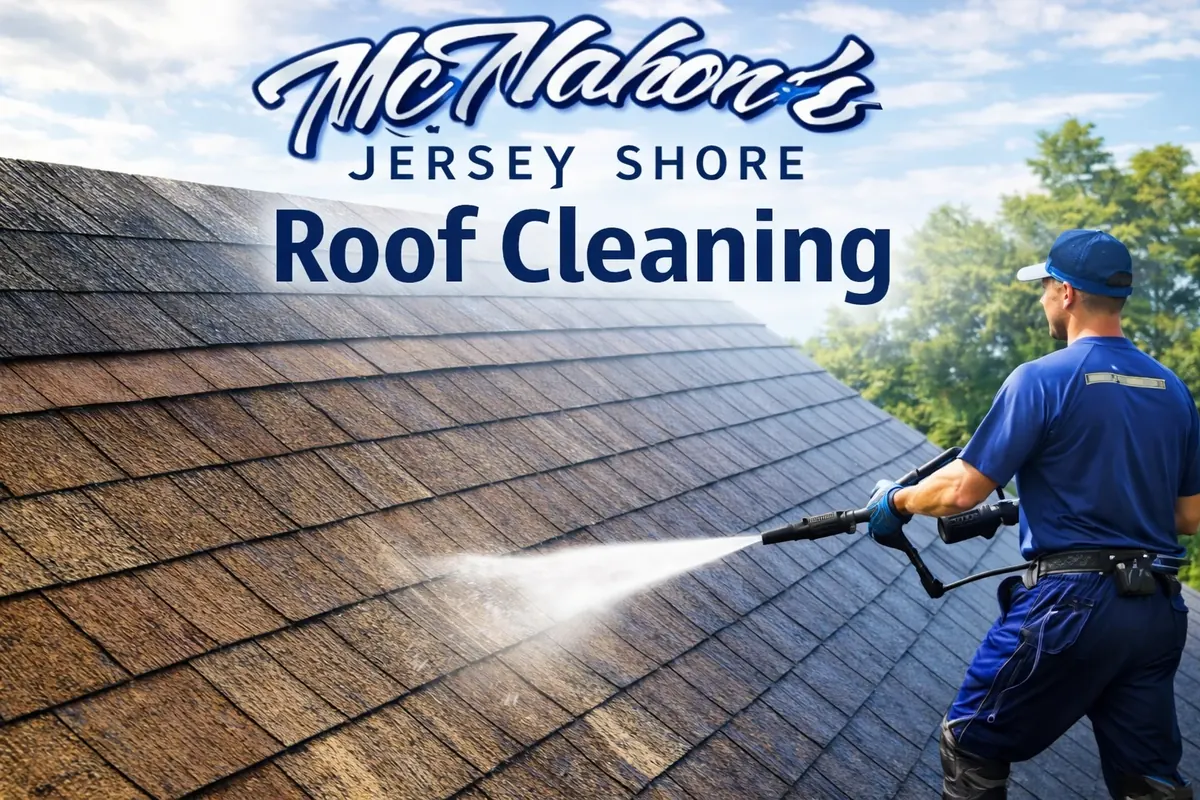
Drive any street in coastal NJ and you’ll see it: dark vertical streaks running down asphalt shingle roofs from the ridge toward the eaves, almost always heavier on the north-facing slope. Most homeowners think it’s dirt, or assume the shingles are wearing out. It’s neither.
Those streaks are a living organism. And if you treat them wrong — or do nothing — they shorten the life of your roof by 5–10 years.
What The Streaks Actually Are
The organism is gloeocapsa magma — a cyanobacteria (sometimes loosely called “blue-green algae”). It is not dirt. It is not mold. It is a photosynthetic bacteria with a hard, dark, UV-resistant outer coat that protects it from sun damage.
It thrives on asphalt shingles for three reasons:
- Limestone filler in shingles. Modern asphalt shingles include crushed limestone as a filler. Gloeocapsa magma feeds on the calcium carbonate. Your roof is, literally, food.
- Moisture retention. Shingle granules hold dew and humidity, especially on north slopes that get less sun.
- Airborne spore distribution. Cyanobacteria spores travel by wind. Once one roof in a neighborhood is colonized, the whole block tends to follow within a few years.
Why The North Side Goes First
You’ll almost always see streaking heavier on the north and east-facing roof slopes. This is not random. The north slope:
- Gets the least direct sunlight, so it dries slowest after rain or dew
- Stays cooler, which extends the moisture window
- Has less UV exposure to inhibit growth
South and west slopes can still get colonization, especially if they’re shaded by trees, but it generally progresses much slower.
What The Streaks Are Doing To Your Roof
This is where it stops being cosmetic and starts being expensive.
1. Granule Loss
The cyanobacteria feeds on the limestone embedded in the shingle granules. As it does, the bond between the granule and the shingle weakens. Granules wash off in heavy rain. Without granules, the asphalt underneath is exposed to UV, which dries and cracks it.
2. Heat Retention
Dark streaks absorb more solar heat. A streaked north slope can run 10–15°F hotter than a clean one on a summer afternoon. That extra heat ages shingles faster and raises your attic temperature — which raises your cooling bill.
3. Moisture Trapping
The bacteria layer holds moisture against the shingle for longer than a clean surface would. Persistent moisture accelerates the breakdown of the asphalt binder.
4. Estimated Life Reduction
The industry consensus from shingle manufacturers and roofing trade groups is that untreated gloeocapsa magma colonization removes roughly 5–10 years from the usable life of a 30-year architectural shingle roof. On a roof that costs $18,000–$30,000 to replace, that’s a real number.
Why You Cannot Pressure-Wash It Off
Every major asphalt shingle manufacturer — GAF, Owens Corning, CertainTeed, IKO — explicitly prohibits pressure washing on their roofs. Their warranty documents call it out by name as an excluded cause of damage. Here’s why:
- Pressure washing physically strips the granules. You see “clean” shingles for 90 days, then the bare asphalt cracks.
- Pressure does not kill the bacteria. The roots stay. Regrowth happens in 6–18 months.
- Driving water under shingle tabs leads to leaks weeks or months later.
We see houses every year where the homeowner power-washed the roof themselves or hired a “cheap” pressure washer. The streaks are gone. The roof is six years from replacement.
What Soft-Wash Actually Does
Soft-washing a roof is a chemistry job, not a pressure job. The process:
- Plant protection. Pre-rinse all landscaping beneath the gutter line. Cover anything that touches the house.
- Apply. A dilute sodium hypochlorite solution (the same active chemical as household bleach, professionally diluted with surfactants) is applied to the roof through a low-pressure pump. Less force than a garden hose.
- Dwell. Solution dwells on the shingles for 10–15 minutes. The bleach oxidizes the cell walls of the bacteria — it kills it at the root, including the spores in the granules.
- Rinse. A light-pressure clean-water rinse clears the dead organic matter and the diluted solution.
The result you see immediately after the wash is dramatic — but it actually keeps improving for 1–2 weeks as remaining dead organisms wash off naturally with rain.
What To Expect After A Roof Soft-Wash
- Days 1–7: Roof looks dramatically better. Some residual streaking may still be visible.
- Weeks 2–4: Residual streaks fade as dead organisms continue to release. Final result becomes apparent.
- Year 1: No regrowth. Most professional jobs include a ARMA-approved soft-wash method.
- Years 2–4: Depending on neighborhood spore load and tree cover, fresh colonization can begin. Maintenance wash typically recommended every 4–6 years on the shore.
What About Zinc And Copper Strips
Some roofers install thin zinc or copper strips at the ridge cap. When rain hits the strip, trace metal ions wash down the slope and inhibit new growth. This works as a prevention measure for a clean roof. It does not remove existing colonization — that still requires a soft-wash first.
If you’re about to re-roof, adding a ridge-line zinc strip is cheap insurance and we recommend it.
Quick Answer
The black streaks on asphalt shingle roofs are gloeocapsa magma, a cyanobacteria that feeds on limestone in the shingles and shortens roof life by 5–10 years if left untreated. Pressure washing strips the granules and voids the manufacturer warranty without killing the organism — regrowth happens within months. Professional soft-washing applies a dilute sodium hypochlorite solution under garden-hose pressure, kills the bacteria at the root, and gives 4–6 years of clean roof on a typical shore home. Results appear within 1–2 weeks as dead organisms continue to rinse off naturally.
If you have streaks and want them gone for good — without taking years off your roof — we soft-wash roofs across the shore and back it with a ARMA-approved method.
More from the field.
Is Powerwashing Safe for Plants and Pets? A Jersey Shore Pro Explains
A careful soft-wash is safe for landscaping and pets when the crew follows the right pre-rinse, dilution, and post-rinse protocol. Here's the chemistry, the plant categories that need protection, and the pet protocol we use on every job.
How Long Does a Soft-Wash Last? (And What Affects It)
A soft-wash on Jersey Shore vinyl siding typically lasts 12-24 months. Here's what shortens it (north-facing walls, tree cover, salt air), what extends it (full sun, clean gutters), and the recurring schedule we recommend.
Send us a photo.
If something on your house looks like what we wrote about, send a phone photo. We'll tell you what method is right, give a ballpark price, and book a walkthrough.
- Mon–Fri 7:00 AM – 7:00 PM
- Sat 8:00 AM – 4:00 PM
- Sun By appointment