Salt Air And Your Siding: Why Jersey Shore Homes Need A Different Wash
Coastal NJ homes weather faster than inland homes because of salt aerosol, humidity, and persistent moisture. Here's the science and what to do about it.
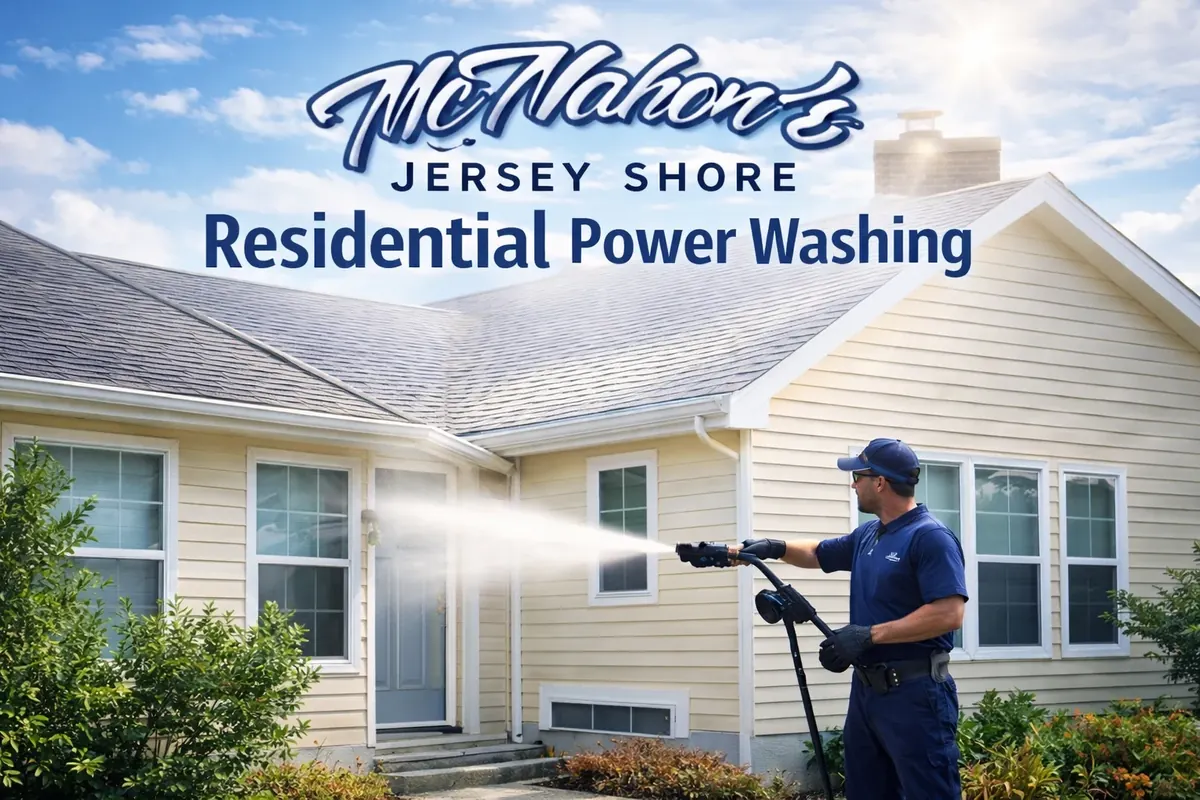
If you live within a few miles of the Atlantic — Point Pleasant, Brick, Bay Head, Mantoloking, Spring Lake, Sea Girt, the bayside neighborhoods of Toms River — your house weathers about twice as fast as a comparable house in a landlocked town. That’s not anecdote. It’s chemistry, humidity, and prevailing wind.
This post explains why coastal homes pick up mildew, algae, and that grimy gray-green film so quickly, what kinds of damage that does long-term, and which wash technique actually solves it without making the problem worse.
Why Coastal Air Eats Siding
Three forces are working against your house every day:
1. Salt Aerosol
Ocean spray doesn’t stay at the beach. The wind lifts microscopic salt droplets — called “salt aerosol” — and carries them inland for miles. Studies from coastal building-science researchers have measured detectable chloride deposition more than five miles from the shoreline. Within the first 500 feet of the ocean, the deposition rate is roughly 10× higher than at one mile inland.
Salt is hygroscopic — it pulls moisture from the air. Once salt is on your siding, it acts like a sponge, keeping the surface damp long after a rain has dried elsewhere. That sustained moisture is what algae and mildew need to colonize.
2. Humidity Plus Dew Cycles
Shore air runs 5–15% more humid on average than central-NJ air. Combine that with overnight dew on dark siding and you have a 6–10 hour daily window where biological growth has all the moisture it needs.
3. UV And Microabrasion
Salt particles are abrasive. As wind blows them across vinyl, paint, or composite, they scour the surface microscopically — opening up texture for spores to grab onto. UV degrades the binder in paint and the surface layer of vinyl. After 5–7 seasons, an unwashed coastal house has measurably rougher surfaces than the same product 20 miles inland.
What’s Actually Growing On Your House
When homeowners say “the siding looks dirty,” they’re usually looking at one of three things — sometimes all three on the same wall:
- Gloeocapsa magma — a cyanobacteria (the same family responsible for black streaks on asphalt shingle roofs). On siding it shows up as gray-to-black streaks under eaves and downspouts.
- Algae — green film, usually on the north and east sides where sun is weakest and surfaces stay damp longest.
- Mildew — black or dark-brown spotting, often under decks, eaves, or near plant growth that holds humidity against the house.
None of these are dirt in the conventional sense. You cannot rinse them off with a hose. They need to be killed with a cleaning solution, not blasted off with water pressure.
Why High Pressure Is The Wrong Answer
This is the most expensive mistake homeowners make: renting a 3,000 PSI pressure washer and going at the house themselves. Here’s what high pressure does to coastal siding:
- Vinyl siding: Pressure above 1,500 PSI at close range can crack vinyl that’s already been UV-embrittled. It can also drive water behind the siding through laps and J-channels — where the water gets trapped against the sheathing and rots the wall over months.
- Painted wood and cedar: High pressure strips paint, gouges the grain, and pushes water into siding joints.
- Stucco and EIFS: High pressure pits the surface and forces water into cracks.
And critically — high pressure does not kill algae. It dislodges the visible top layer, the colony comes back in 4–6 months, and you’re back where you started.
Soft-Wash: The Right Method
Professional exterior cleaning on the shore is almost always a soft-wash job — meaning low water pressure (under 500 PSI, often closer to garden-hose level) plus a cleaning solution that actually kills the organisms.
A typical soft-wash mix uses:
- A diluted sodium hypochlorite solution (the same active chemical as household bleach, applied through a dedicated low-pressure pump)
- A surfactant to help the solution cling to vertical surfaces long enough to do the work
- A clean-water rinse pass once the solution has had its dwell time
The solution kills the algae and bacteria at the root. The rinse pass clears the dead organic matter. Two weeks later, no regrowth — versus the 4–6 month rebound of a pressure-wash-only job.
How Often Should A Shore Home Be Washed
Rules of thumb for coastal NJ:
| Distance from ocean | Recommended frequency |
|---|---|
| Within 500 feet (oceanfront / first row) | Every 12 months |
| Within 1 mile | Every 18–24 months |
| 1–5 miles | Every 24–36 months |
| Inland of Route 9 | Every 36–48 months |
Houses with heavy tree cover, north-facing walls, or persistent shade tend to need washing more often than the table suggests because biological growth has more cover.
What To Look For When Hiring
- Soft-wash capability — not just a high-pressure rig. Ask if they have a dedicated soft-wash pump and what their dilution rates are.
- Plant protection process — pre-rinse, cover, post-rinse. Sodium hypochlorite will burn landscaping if it isn’t diluted on contact with water and rinsed promptly.
- Insurance — fully insured residential and commercial, COI available on request for commercial and HOA jobs.
- proof of insurance.
Quick Answer
Coastal Jersey Shore homes weather faster than inland homes because salt aerosol traps moisture against the siding, humidity stays elevated 5–15% above inland averages, and UV plus microabrasion roughen surfaces that algae and mildew can colonize. The fix is soft-wash with a diluted bleach-based cleaner — not high-pressure water alone, which doesn’t kill the organisms and can damage vinyl, paint, and stucco. Most shore homes need a wash every 1–3 years depending on proximity to the ocean.
If you want a walk-through and a price for soft-washing your shore home, we’re a phone call away.
More from the field.
Is Powerwashing Safe for Plants and Pets? A Jersey Shore Pro Explains
A careful soft-wash is safe for landscaping and pets when the crew follows the right pre-rinse, dilution, and post-rinse protocol. Here's the chemistry, the plant categories that need protection, and the pet protocol we use on every job.
How Long Does a Soft-Wash Last? (And What Affects It)
A soft-wash on Jersey Shore vinyl siding typically lasts 12-24 months. Here's what shortens it (north-facing walls, tree cover, salt air), what extends it (full sun, clean gutters), and the recurring schedule we recommend.
Send us a photo.
If something on your house looks like what we wrote about, send a phone photo. We'll tell you what method is right, give a ballpark price, and book a walkthrough.
- Mon–Fri 7:00 AM – 7:00 PM
- Sat 8:00 AM – 4:00 PM
- Sun By appointment